


Essentialism Meets Effortless
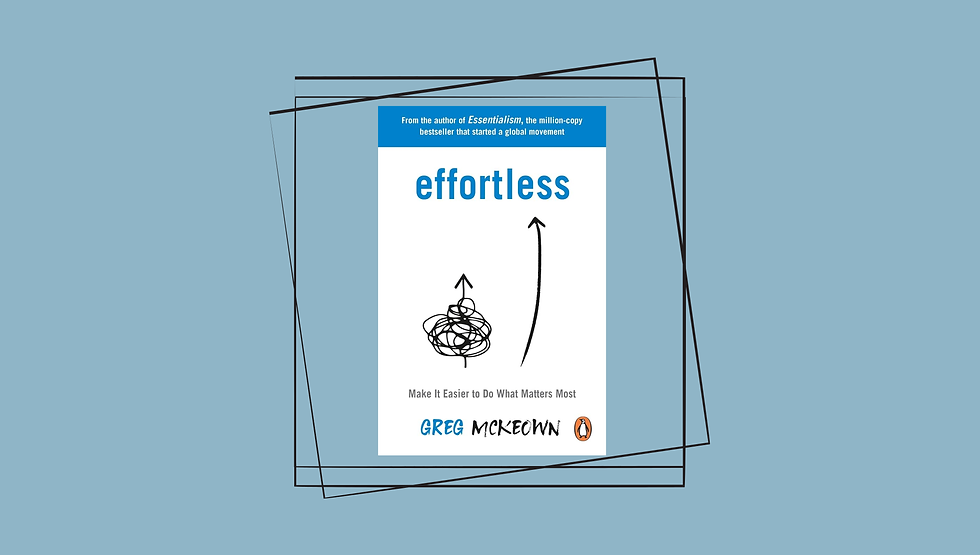
Right Things vs Right Way
Essentialism = Do the right things. Effortless = Do those right things the right way.
Essentialism answers:
What truly matters?
Effortless answers:
How do I make what matters easier and sustainable?
The Jar and Rocks — The Real Meaning
The author tells an anecdote about how small rocks if put first will fill a big jar and there will be no room for large rocks. Instead if we put the large rocks first, there will be room for smaller rocks.
In Life -
Large rocks = health, relationships, purpose, deep work
Small rocks = emails, errands, noise, reactive tasks
If you fill life with small rocks first, the big ones never fit.
What if there are too many “large rocks”?
This is where Effortless comes in. You don’t solve competing priorities with more effort. You solve them with leverage and design.
The Core Framework
Effortless State → Effortless Action → Effortless Results
Its a linear process which builds on top of the step prior.
Effortless State (Inner Design)
Before optimizing work, optimize your energy and clarity.
Invert – “What if this were easy?”
We assume:
Success = struggle
Worthy = hard
Growth = painful
What is it could be reframed or as the author suggests, reverted?
Instead of asking “How do I push harder?”
Ask:
How can I make this to be easy? What’s the simplest, most easy version of this?
That question alone reduces mental friction.
Enjoy – “What if this were fun?”
Pair something difficult with something pleasurable. Habit stacking = psychological leverage.
Turn a tedious task into a meaningful ritual.
Example:
Listen to podcasts while walking
Do budgeting at your favorite café.
Transform your skincare routine into an evening ritual by lighting candles or playing music
This activates behavior by reducing resistance.
Release – Let go to move forward
Holding resentment, perfectionism, or control creates mental blocks and drains energy.
Practice gratitude and letting go. It frees you from emotional and cognitive burdens
When you focus on what you have, you get what you lack.
Rest
Rest isn’t laziness. It’s strategic recharge and renewal.
No rest → no clarity → no leverage.
Take naps, mid work breaks or disconnect from work as required
Presence
Scattered attention leads to energy wastage while focused attention multiplies effort. Focus on the essential and let go of the rest
Presence also helps deepen relationships as it prevents judgement or opinions from over-taking a conversation or interaction. It allows different perspectives to co-exist which leads to stronger and resilient relationships to form over-time.
Effortless Action (Outer Design)
Once we are aligned internally, now we simplify execution through some key principles.
1. Define what “Done” looks like - Envision the end state
Ambiguity creates friction, clarity reduces it.
For each goal that you set, be specific and define what ‘done’ looks like.
Vague Goal : Work on fitness
Measurable Goal : Walk 7,000 steps daily.
Your brain relaxes when it knows the finish line.
2. Start Tiny (Minimum Viable Action)
Massive goals = Overwhelm and paralysis. Break your goals down into simplest, most doable action and then take the first step.
Big Goal: “Build data science portfolio.”
Start:
“Open Jupyter notebook.”
“Write one function.”
You lower activation energy.
3. Simplify
Instead of simplifying the steps, eliminate the non-essential steps entirely.
Most processes are bloated. Elimination creates momentum.
4. Progress Over Perfection
Don’t wait for things to be perfect, take the first step now.
Perfection delays results. Early failure provides feedback and thus accelerates learning.
Iteration > perfection
5. Pace Yourself
Set:
A floor (bare minimum)
A ceiling (max effort limit)
This prevents burnout cycles.
Effortless Results
Once you have achieved the right state and taken the effortless action, then what is needed is for you to achieve your desired results repeatedly with little additional effort.
Results could be categorized broadly into two types - Linear and Residual
Linear Results | Residual Results |
Start from zero every day | Effort once |
Effort = immediate output | Benefit repeatedly |
Stop effort → stop results | Compounding over time |
Output → feeds back → increases future output. | |
It’s a treadmill. | This is leverage. |
Example: | Examples: |
• Freelancing hourly | • Writing a book |
• Daily gym session | • Building a skill (Skill → better opportunities → more learning → better skill.) |
• Daily client work | • Investing money (Interest earns interest.) |
• Automating systems | |
• Recording a course | |
• Building reputation (Trust → collaboration → deeper trust.) |
Residual results are due to a concept called ‘leverage’ which helps maximize our output and help achieve the desired results without putting in more effort.
Applications of Leverage
How do I reduce effort but increase impact?
Leverage types:
Knowledge (learn once, apply repeatedly)
Systems (automate decisions)
Technology (scale output)
Capital (money working for you)
Relationships (networks multiply opportunities)
Example Goal - To become a data scientist
Linear approach:
Study daily → forget → repeat.
Residual approach:
Build GitHub projects
Write explainers
Create reusable code templates
Build a personal knowledge system
That compounds.
The Bottomline
Essentialism says: Cut down to fewer big rocks.
Effortless says: Design those big rocks so they don’t crush you.
The real takeaway: You don’t win by doing more.
You win by:
Choosing fewer things.
Making them easier.
Designing them to compound.
Now let me ask you something thoughtful: When you look at your current life — Are you exhausted because of too many rocks? Or because you’re carrying them inefficiently?
That distinction changes everything.


Comments